what is necessary in order for skin and muscles to be fossilized?
Fossils are rare considering their formation and discovery depend on bondage of ecological and geological events that occur over deep time.

Courtesy of Holly Dunsworth
Simply a small fraction of the primates that have ever lived has been preserved as fossils. After death, most primate bodies are eventually dismantled and devoured by predators, scavengers, and microbes. If not, then their remains undergo chemical decomposition and, ultimately, their molecules are scattered beyond the ecosystem and recycled. The same is true for all organisms throughout history. Considering life equally we know it depends on the death and decomposition of organisms, the fossil record is necessarily incomplete. As such, finding fossils involves non simply perseverance and luck, but the discovery of any particular fossil also depends on the run a risk that the specimen preserved in the outset place. Although fossilization affects only a small fraction of the organisms that have ever lived, there are well-documented conditions that foster the process. Thanks to Efremov's founding of the science of taphonomy -translated from its Greek roots significant "laws of burial" - the steps to fossilization are non as mysterious as they in one case were (encounter Shipman, 1993). The following taphonomic sequence will increment a primate's chances of becoming a fossil that will one day be studied by paleontologists and marveled at by museum visitors.
1. Death
The primate dies. This may occur within the primate's habitat or, for example, the carcass might exist deposited in a carnivore den.
2. Fail
For the best chances of fossilization, the primate carcass will be largely neglected until information technology is cached: i.e., non entirely destroyed by predators and scavengers, trampled by other organisms, washed downward a turbulent riverbed, and, ultimately, not completely recycled into the ecosystem so that parts of its teeth and bones are left intact (Figure 1). Fifty-fifty when such things occur, fossilization can and does proceed, but the forces that dismantle the carcass diminish the likelihood of fossilization and greatly reduce opportunities for discovery, identification, and analysis of the ancient primate'due south remains. Yet, the processes that touch on the carcass form an important role of the context scientists need to best understand the circumstances of the death - and by extension, life - of the ancient primate.

Figure 1: Ape feet
Articulated bones of the right and left feet of an adult Proconsul heseloni (museum catalog no. KPS III). These ape feet remained intact upon burying and during fossilization, and were excavated roughly 20 million years afterwards at the Kaswanga Primate Site, Rusinga Island, Republic of kenya.
© 2022 Alan Walker
3. Burying
The primate carcass is cached by geologic processes. The sediment in which information technology is buried cannot be too acidic. Some silty lake bottoms are hospitable environments, and and so are bogs and tar pits which lack many micro-organisms which could further disintegrate the remains. Although some wet environments, peculiarly anaerobic ones, offer fossil-friendly atmospheric condition, then do very dry ones. Sedimentation occurs most ofttimes and most apace in places where water and air are moving, or when other events (for case, volcanic eruption) eolith soil, sand, mud, ash, or dust on the mural. If the primate dies in proximity (space and fourth dimension) to such sedimentary forces, then its chances for fossilization are improved. Burial by volcanic ash is especially helpful considering, depending on the geochemistry of the ejected sediment, not merely could the weather foster fossilization, just the sediment could be dated past geochronologists. Ideally, underground microbes, burrowing animals, and found roots do non disturb, interruption, or disperse the remains any farther.
4. Fossilization

Figure 2: Primate skeleton
Nearly consummate ~47 million-year-old fossil primate skeleton with soft-tissue body outline (indicated by the darkly stained matrix) of Darwiniusmasillae from Messel, Germany. Scientists discovered organic remains of food (leaves and a fruit) in the digestive tract preserved in the abdominal region.
© 2009 Franzen JL, Gingerich PD, Habersetzer J, Hurum JH, von Koenigswald Due west, Smith BH (2009) Complete Primate Skeleton from the Middle Eocene of Messel in Germany: Morphology and Paleobiology. PLoS Ane iv(5): e5723. doi:ten.1371/journal.pone.0005723 All rights reserved. 
In one case cached in what is now termed the matrix, the organic materials that comprised the living primate can begin to atomize or to chemically change forth with the matrix. Over deep, or "geologic," time, and with the correct temperature, chemical, and pressure conditions, hard rocks are formed from soils, sands, silts, muds, ashes and other types of loose sediment. This process is called diagenesis and refers to the lithification of both the sediment to the biological remains within the sediment. When one time-living organisms are transformed into rocks or leave impressions or imprints inside rocks, then those rocks are referred to as fossils, and the process is known as fossilization. Trace fossils are imprints left in sediment by an organism - either during its life (e.g. footprints, insect nests, and tooth pits on the bones of casualty) or during its decease - that get stone. Many small-scale soft-bodied creatures are preserved this way and it is how a primate's pilus, skin, and organs tin preserve (e.g. Franzen et al., 2009; Effigy 2). However, these are very rare cases. Instead, primates are usually preserved as petrified teeth and bones that tin can be extracted from the surrounding rock. These kinds of fossils can be formed in 2 major ways.
Casts occur when the decaying remains dissolve completely and leave a infinite that becomes filled-in or replaced past sediment which then becomes stone. This is how brains fossilize and sometimes how whole organisms, like invertebrates, can be preserved (Effigy iii). This process of replacement can likewise extend to isolated bones and fossils if none of the original material is preserved.

Effigy iii: Fossilized Grasshoppers
Two fossilized grasshoppers constitute preserved in a deinothere (aboriginal elephant relative) footprint near the R114 ("ape in the tree") site on Rusinga Island, Republic of kenya. The one in the dorsum is flipped upside down.
© Alan Walker
Still, much of what primate paleontologists collect and study are not only casts only are comprised, in function at to the lowest degree, of the actual fossilized basic and teeth that have transformed over deep time (Figure 4a & 4b). Os, similar woods, is porous and full of canals which, when the bone is buried, are filled-in by the calcite or silica (or other minerals and compounds) that precipitate out of the ground water or that leech out of the surrounding sediment matrix. These new minerals may change the color of the remains. In add-on to petrifying or cementing the biological tissues, this process may likewise leave the delicate cellular structures intact.
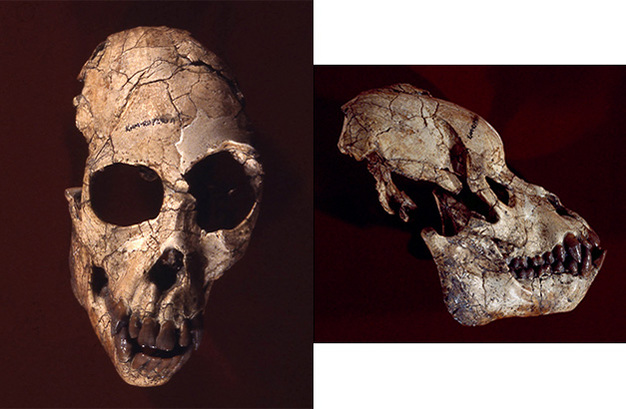
Figure 4a & 4b: Skull teeth and basic
Front (4a) and correct lateral (4b) views of the fossilized teeth and basic of the skull of Proconsul (museum catalogue no. KNM-RU 7290). Mary Leakey discovered this specimen, well-known for its remarkable preservation, on Rusinga Isle, Kenya in 1948. Images are not perfectly to scale with ane another.
© Alan Walker
Molar enamel is densely packed with a durable mineral called hydroxyapatite, which makes teeth much better than bones at withstanding the chemical and physical degradation that occurs during fossilization. As a result, teeth are the most arable elements in the primate fossil record. Fortunately, paleontologists can use tooth morphology to identify species fairly accurately.
Diagenesis is not a uniform process. Some remains experience fossilization quickly, and some slowly, depending on the conditions. Specimens that are nly partially fossilized are dubbed "subfossils." These include the skeletal remains of animals that have recently gone extinct, like many species of giant lemurs on Madagascar, some of which were lost inside the last 2,000 years (Godfrey et al., 2006). These recent fossils may also preserve DNA, which has been successfully extracted from the remains of subfossil lemurs (Karanth et al., 2005) and Neanderthals (Green et al., 2006).
Deep, geologic time is admittedly crucial to fossilization (and also to the evolutionary processes revealed past the fossil record). There are tricks for attempting to comprehend deep time like unrolling a long strip of paper and ticking off time intervals over millions of years (e.g. Mr. Croll'south strip of newspaper (Darwin, 1872)); calibrating distances on the globe to lucifer depth of fourth dimension (Parker, 2011); or animative a few branches of the primate fossil record into a timeline (Dunsworth, 2011). Demonstrations similar these reveal the fact that there are more gaps in the fossil record than in that location are fossils. Globe'south evolutionary history includes so many organisms and covers such deep fourth dimension that it is taking generations upon generations of paleontologists to get out into the field, collect new specimens, and fill in the gaps in the fossil record, a subset of which is the primate fossil tape.
five. Discovery
Earlier undertaking an trek to collect fossil primates, paleontologists outset look to geologic maps of a region to determine if rocks of the correct time menstruum are really nowadays and exposed on the landscape. If they are interested in finding the most ancient fossil apes, like Proconsul, so they look for rocks that have been dated to the early Miocene epoch. If the rocks accept not been dated either absolutely or relatively with stratigraphic methods, and then prior collections from the region may demonstrate that early on Miocene species are nowadays, indicating that Proconsul may be present equally well.
Once rocks of the correct age are pinpointed on a map, then paleontologists may use Google Earth and aeriform photographs or they might visit by airplane, automobile or foot to determine if those rocks are exposed and accessible and free of thick vegetation, agricultural crops, or water embrace.
The give-and-take "fossil" derives from the Latin verb fodere which ways "to dig." Yet, i need not always dig in order to find fossils. There are localities such as Koobi Fora in northern Kenya (Figure v) and Rusinga Island in western Kenya (Effigy 6a & 6b) where many fossil primates have been establish and where vertebrate fossils litter the footing.
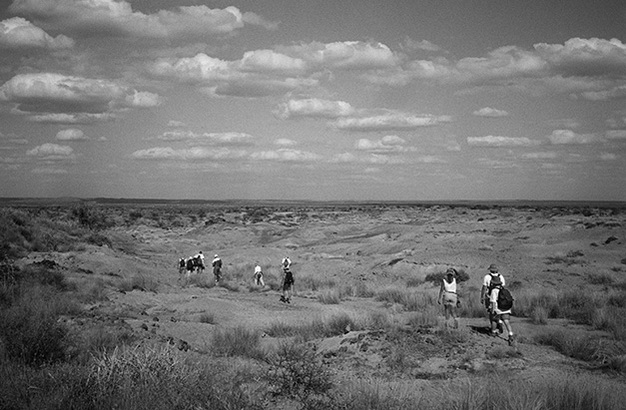
Figure 5: Hiking through Kenya
Paleoanthropologists and students hike through fossiliferous badlands at Koobi Fora, Kenya where fossil primates belonging to Theropithecus, Australopithecus, Homo, and others have been collected.
Courtesy of Holly Dunsworth. All rights reserved.
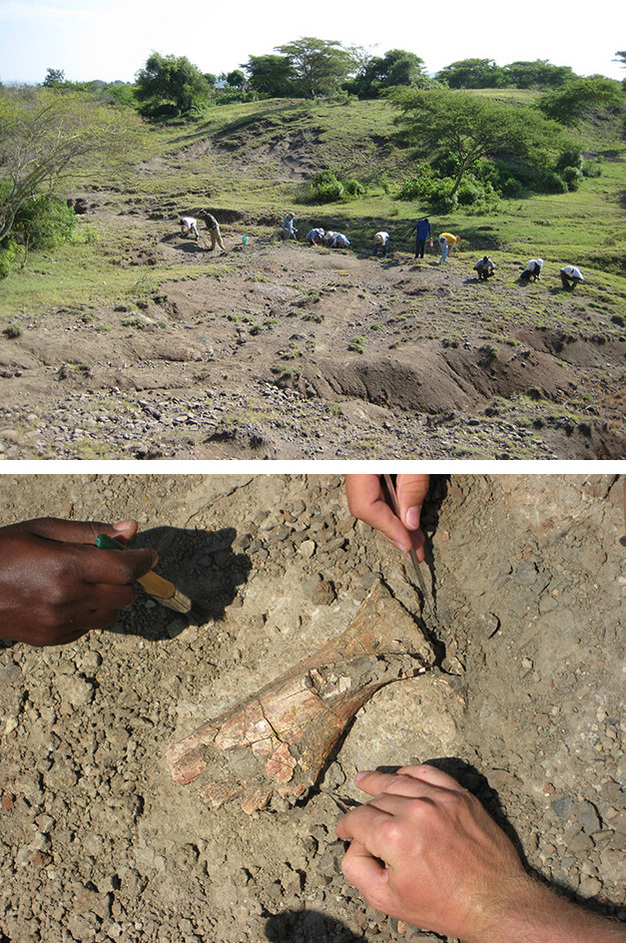
Figure 6a & 6b: Paleoanthropologists at work
Paleoanthropologists systematically survey (peak/6a) and excavate a cleaved bone from a large mammal (bottom/6b) at sites on Rusinga Isle where fossils of the stem ape Proconsul have been collected as along with other primates like Dendropithecus and Mioeuoticus and hundreds of other fossil vertebrates and invertebrates and even fossil leaves, tree roots, and tree trunks.
Courtesy of Holly Dunsworth. All rights reserved.
Summary
Primate fossils are often hard to detect, non because they are hard to see, just considering of the slim chance that a dead primate will be preserved, transformed into stone, and then found thousands or millions of years later on. If a primate is going to go a fossil, then information technology needs to get buried apace earlier other organisms devour and besprinkle its bones. Information technology should die near a river, pond or lake, for example, where water is constantly edifice upward sediment. The sediment cannot be too acidic or contain too many micro-organisms since these promote chemical degradation. If the conditions are sufficient, the organic materials in the primate'southward bones and teeth lose their organic properties and take on the mineral and chemical backdrop of the surrounding matrix. This transformation is fossilization. Over time, every bit the bones and teeth and the surrounding sediment metamorphose, soft tissues are rarely preserved. Yet, crania may leave encephalon casts behind and skin may exit impressions as trace fossils. Paleontologists strategically survey rocks with geologic ages that correspond to the chapter in Globe'due south evolutionary history that they're interested in learning about. For primate development, that chapter begins roughly 65 meg years ago, continues through to today, and will stop at an unknown time in the future.
Post Script: Context is everything
Fossil remains reveal the paleobiology of the organism, simply none of that information has any scientific value without context, which includes data like the location, the sedimentary matrix, the taphonomy, and the historic period of the specimen. Without context, scientists cannot relate a fossil to other living or fossil organisms. Agreement change over time - adaptation, variation, relatedness of organisms (a.yard.a. phylogeny), and so on - are the goals of paleontology, and knowing the context of fossils is admittedly crucial for making or breaking scientific hypotheses. If a fossil has no context, so it cannot be placed in the Tree of Life, it cannot be evolutionarily linked to living organisms, and, therefore, it tin do zilch to further our understanding of how evolutionary processes work and how nowadays-day species arose.
Many governmental agencies require that people obtain permits before collecting fossils, and this is done, in role, to protect a fossil's context. In the United states information technology is illegal to remove fossils from public lands similar National Parks. (Learn almost Utah'due south fossil collecting rules and regulations here: http://geology.utah.gov/online/pdf/pi-23.pdf. Meet Kenya'due south requirements on the website for the National Museums of Republic of kenya: http://www.museums.or.ke/.) When someone picks up fossils, hikes them out to the nearest town, and sells them at a shop, then those fossils are rendered scientifically meaningless. Without context, fossils are just funny looking rocks.
Glossary
anaerobic - refers to conditions with no oxygen and refers also to the survival processes undertaken in these conditions
decomposition - rotting
diagenesis - a general term variably used to describe the conditions and processes involved in turning biological and geological affair into rock or into a different rock
ecosystem - a circuitous network of life and non-life
fossilization - the process past which fossils are formed
fossils - mineralized remains or impressions of once-living organisms
geochemistry - refers to the particular chemical makeup of a sediment or rock, and to the processes involved in identifying information technology
geochronologists - scientists who are concerned with estimating the ages of rocks and dating the fossils that are found within or in association with those rocks
habitat - where an organism spends much of its time, usually determined by the other organisms that overlap with information technology, by the available molecules in the rocks and groundwater, and also by the climate
lithification - the process of a substance turning into rock or rock
matrix - in paleontological terms, it is the sediment or the stone surrounding basic or fossils
morphology - size and shape of an organism or its anatomy
organic - refers to the carbon compounds that comprise living organisms, similar those that brand up our muscles
paleontologists - scientists that study the physical testify for evolution, the fossilized remains, and other associated evidence, of organisms that lived and died in the past
primates - mammals belonging to the Lodge Primates including humans, apes, monkeys, tarsiers, lemurs, and lorises
sediment - dirt
taphonomy - the processes that change the remains of an organism from the time of its death to the fourth dimension of its discovery, and the scientific understanding of those processes
trace fossils - when impressions of the once-living organism are left behind, ofttimes preserving behavior such as locomotion and posture (foot and torso prints) and nutrition (tooth pits on bones)
References and Recommended Reading
Darwin, C. Origin of Species, 6th edition. London: John Murray (1872).
Dunsworth, H.M. Deep fourth dimension in perspective: An animated fossil hominin timeline. PaleoAnthropology 2011, 13-17 (2011). [To download and watch the movie discover the "zero" file linked here: http://www.paleoanthro.org/journal/2011/]
Franzen, J.L., Gingerich, P.D. et al. Complete primate skeleton from the middle Eocene of Messel in Deutschland: Morphology and paleobiology. PLoS ONE four(5), e5723 (2009). [doi:ten.1371/journal.pone.0005723]
Godfrey, Fifty.R., Jungers, W.L., & Schwartz, G.T. Ecology and extinction of Madagascar'southward subfossil lemurs. In Lemurs: Ecology and Adaptation. ed. Gould, L. & Sauther, Chiliad.L. (New York: Springer 2006) 41-64.
Green, R.East., Krause, J. et al. Analysis of one million base pairs of Neanderthal Deoxyribonucleic acid. Nature 444, 330-336 (2006).
Karanth, K.P., Delefosse, T. et al. Aboriginal DNA from behemothic extinct lemurs confirms single origin of Malagasy primates. PNAS 102(14), 5090-5095 (2005).
Parker, J.D. Using Google Earth to teach the magnitude of deep time. Periodical of College Science Didactics twoscore(five), 23-27 (2011).
Shipman, P. Life History of a Fossil: An Introduction to Taphonomy and Paleoecology. Cambridge, MA: Harvard Academy Press (1993).
Walker, A. & Teaford, 1000. The hunt for Proconsul. Scientific American 260(1), 82 (1989).
Walker, A. & Shipman, P. The Ape in the Tree. Cambridge, MA: The Belknap Press of Harvard University Press (2005).
Source: https://www.nature.com/scitable/knowledge/library/how-to-become-a-primate-fossil-135630567/

Post a Comment for "what is necessary in order for skin and muscles to be fossilized?"